By Dr. Candace Thornton Spann, board-certified dermatologist | October 21, 2026
When skin cancer shows up on your face, treatment has two goals. The first is to remove all of the cancer. The second is to repair the area so it heals well, works normally, and looks as natural as possible. At Couture Dermatology & Plastic Surgery in Las Vegas, both steps are planned together: the dermatology team diagnoses and removes the cancer, and the plastic surgery team plans the repair. Reconstruction is often done the same day as removal or the day after.
Knowing how the process works before your procedure can make a stressful diagnosis feel more manageable. This guide from board-certified dermatologist Dr. Candace Thornton Spann walks through each step.
Skin cancer is the most common cancer in the United States, and the American Academy of Dermatology estimates that about one in five Americans will develop it in their lifetime. The most common types, basal cell carcinoma and squamous cell carcinoma, tend to form on skin that gets the most sun over the years. That makes the face, ears, lips, and scalp common locations. You can learn more in the AAD's guide to basal cell carcinoma.
The face presents challenges that other areas don't:
Function matters. The eyelids, nose, and lips have to move and work normally after surgery.
The skin is thin and tightly fitted in areas like the nose, eyelids, and ears, so there is less loose skin available to close a wound.
Scars are visible. Every repair has to account for natural creases, contours, and skin tone.
This is why the plan for repairing the area should be made before or at the same time as the plan for removing the cancer.
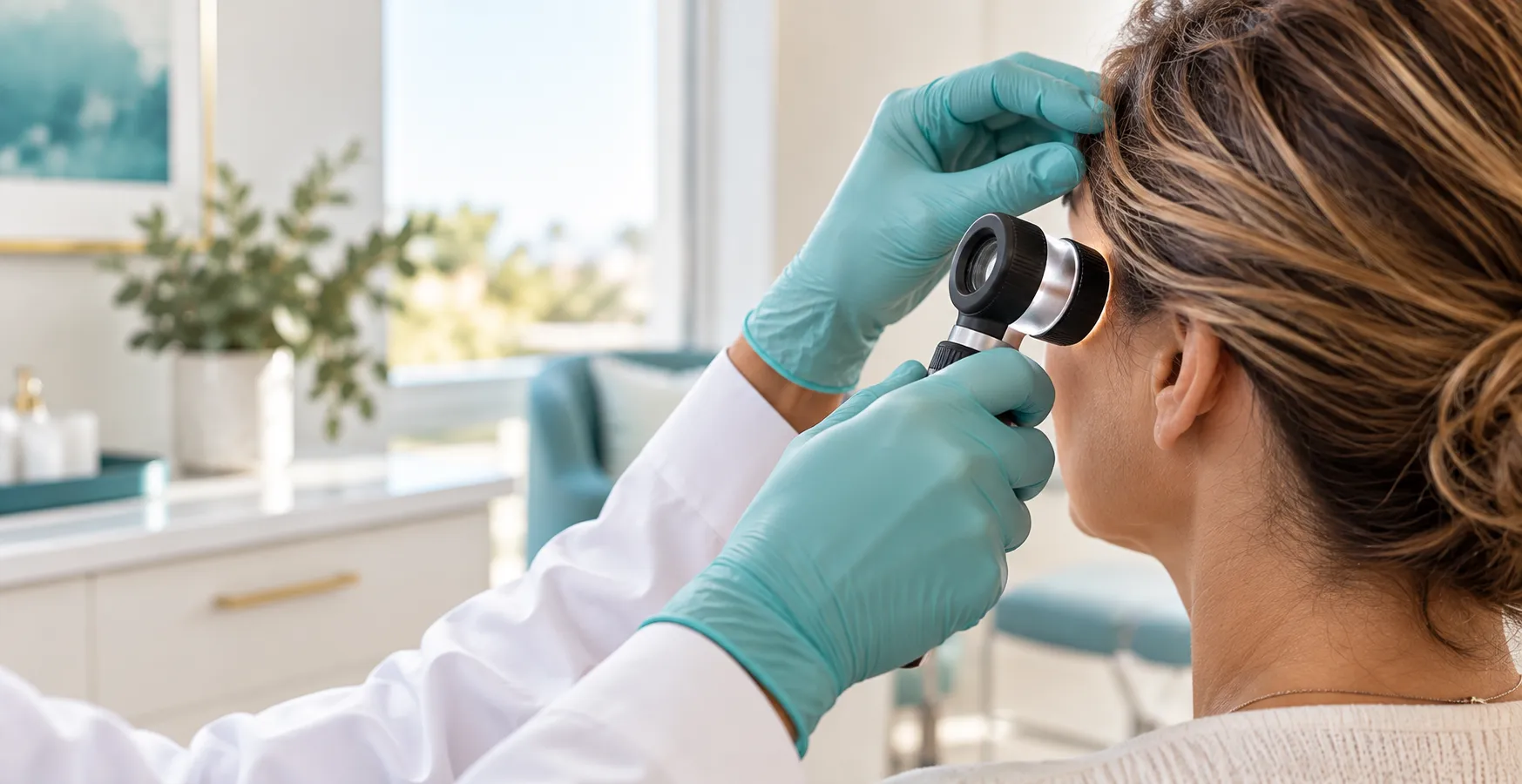
Everything starts with an accurate diagnosis. A board-certified dermatologist examines the spot, often using a magnifying tool called a dermatoscope, and asks about changes you've noticed, your sun exposure, and your personal and family history of skin cancer.
If a spot looks suspicious, the next step is usually a biopsy: a small sample is removed under local anesthesia and sent to a lab. The results confirm whether it is cancer, what type it is, and how deep it goes. That information shapes every decision that follows.
At Couture, Dr. Candace Thornton Spann and the dermatology team provide skin cancer diagnosis and treatment. If you haven't had a full-body skin check recently, our guide to skin cancer screening in Las Vegas explains what to expect.
Removing the cancer completely always comes first. Appearance never takes priority over getting clear margins, meaning no cancer cells remain at the edges of the removed tissue. Your dermatologist will recommend a removal method based on the type, size, depth, and location of the cancer.
Common approaches include:
Surgical excision. The dermatologist removes the cancer along with a small margin of healthy-looking skin around it, and the tissue is sent to a lab to confirm the margins are clear. At Couture, Dr. Candace Thornton Spann performs excisions for skin cancer.
Mohs surgery. For some skin cancers on the face, a specialized technique called Mohs surgery may be recommended. The Skin Cancer Foundation explains that it is done in stages during a single visit: a thin layer of tissue is removed and checked under a microscope while you wait, and the process repeats only where cancer remains. This spares as much healthy tissue as possible.
Other treatments exist for certain early or superficial cancers. The National Cancer Institute's overview of skin cancer treatment describes the full range. Your dermatologist will explain why a particular method fits your situation.
If another physician is removing your cancer, such as a Mohs surgeon, you can still plan your reconstruction at Couture. Our plastic surgery team works directly with the doctor performing the removal, and it is best to schedule the reconstruction consultation before your removal date.
Once the cancer is fully removed, the wound is repaired. The best technique depends on the size and depth of the wound, where it is on your face, how much loose skin is nearby, and your overall health. Options include:
Direct closure. The edges of the wound are stitched together in a straight line, ideally placed along a natural crease or contour.
Local flap. Nearby skin, still attached to its own blood supply, is shifted or rotated to cover the wound. Flaps are often used on the nose, cheeks, and around the eyes and lips, because the moved skin closely matches the color and texture of the surrounding area.
Skin graft. A thin piece of skin is taken from another area, such as in front of or behind the ear, and placed over the wound when there isn't enough nearby skin for a flap.
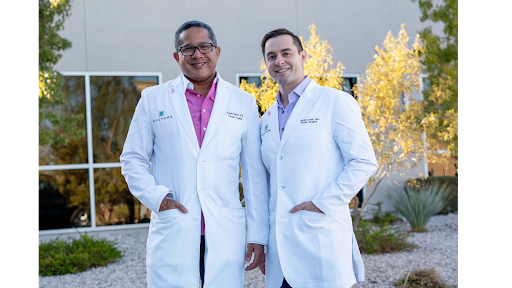
The American Society of Plastic Surgeons' overview of skin cancer removal notes that no surgery is completely scar-free, and that the goal is to treat the cancer without dramatically changing your appearance. At Couture, reconstruction is performed by board-certified plastic surgeon Dr. Marvin Spann or plastic surgeon Dr. Mitchell Lyons, who will review the options with you and explain why they recommend a particular approach.

In many practices, removal and reconstruction happen in separate offices, with separate schedules, and sometimes with a wait in between. At Couture, the dermatology and plastic surgery teams work under one roof, in a practice founded by board-certified dermatologist Dr. Candace Thornton Spann and her husband, board-certified plastic surgeon Dr. Marvin Spann.
For patients, that coordination can mean:
Timing that is planned in advance. Reconstruction is often performed the same day as removal or the next day, and it can be scheduled later if you prefer.
One team that knows your case. The physicians removing the cancer and repairing the wound can review your pathology, location, and goals together.
Fewer handoffs. Your follow-up visits, wound care questions, and scar care happen in one practice.
Every case is different, and your surgeons will recommend the timing that is safest for you.
Most facial skin cancer removal and reconstruction is done under local anesthesia, so the area is numb while you stay awake. For larger or more complex repairs, sedation or general anesthesia may be an option.
After the repair, the area is closed and bandaged, and you receive wound care instructions. These typically include how to clean and dress the area, which topical products to use, and how to protect it from the sun. Bring someone to drive you home if you will have sedation, or if your procedure is near your eye and a bandage could affect your vision.
Recovery depends on the size and location of your repair. Swelling and bruising are common at first, especially around the eyes. Most patients return to normal activities within a few weeks.
Scars keep changing for months. It can take up to a year for a scar to reach its final appearance, and it often looks redder or firmer early on before it softens and fades. In some cases, a small follow-up procedure can further refine the result once healing is complete.
Sun exposure can make a healing scar darken or become more noticeable, and in Las Vegas the sun is strong nearly year-round. While your skin heals:
Keep the area covered or out of direct sun as directed.
Once your surgeon says it's safe, apply a broad-spectrum sunscreen with an SPF of 30 or higher every day, and reapply when you're outdoors.
Wear a wide-brimmed hat and sunglasses, especially for repairs on the nose, ears, or around the eyes.
Plan outdoor activities for early morning or evening when possible.
The AAD's guide to checking your skin is also worth bookmarking. After treatment, your dermatologist will recommend a schedule of follow-up skin exams, and regular self-checks at home help you notice anything new between visits.

What type of skin cancer do I have, and how deep is it?
Which removal method do you recommend, and why?
Who will perform the removal, and who will perform the reconstruction?
Will reconstruction be done the same day, or later?
What repair technique do you expect to use, and where will the scar be?
What will recovery look like, and when can I return to work or exercise?
How should I care for the scar, and when can I start using sunscreen on it?
If you've been diagnosed with skin cancer on your face, or if you have a spot that is new, changing, bleeding, or not healing, the next step is an appointment with a board-certified dermatologist. If your removal is already scheduled elsewhere, a reconstruction consultation before that date gives you the most options.
Schedule an appointment at Couture Dermatology & Plastic Surgery, learn more about skin cancer reconstruction at Couture, or explore our full range of dermatology services. Reconstruction is part of cancer care at Couture beyond the skin as well; our guide to breast reconstruction after mastectomy explains those options.
Is skin cancer reconstruction done the same day as removal? Often, yes. At Couture, reconstruction is frequently performed the same day as the removal or the following day. It can also be scheduled later if you prefer or if your situation calls for it.
Will I have a scar after skin cancer surgery on my face? Any surgery leaves a scar. Careful planning, such as placing incisions along natural creases and choosing the right repair technique, helps make it less noticeable. Scars typically fade and soften over several months to a year.
Can Couture reconstruct the area if another doctor removes my skin cancer? Yes. Couture's plastic surgery team works with the physician performing the removal. Schedule your reconstruction consultation before your removal date so both teams can coordinate.
Does skin cancer come back after it's removed? The risk depends on the type of skin cancer and how it was treated. Having had one skin cancer is also a reason to keep up with regular skin exams, so any new or returning spot is found early. Your dermatologist will recommend how often to be checked.
Dr. Candace Thornton Spann is a board-certified dermatologist, a diplomate of the American Board of Dermatology, and a fellow of the American Academy of Dermatology. She earned her Bachelor of Science degree at UCLA and her medical degree at Meharry Medical College, then completed her internship and dermatology residency at St. Luke's-Roosevelt Hospital Center in New York City, a Columbia University program. A Las Vegas native, she returned home to practice in 2009, and in 2012 she co-founded Couture Dermatology & Plastic Surgery with her husband, board-certified plastic surgeon Dr. Marvin Spann. Her areas of focus include women's hair loss, skin cancer prevention and treatment, and caring for patients of all ages and skin types.
Read Dr. Candace Thornton Spann's full bio
This article is for general education and is not medical advice. Results vary, and every procedure carries risks. An appointment with a board-certified dermatologist or plastic surgeon is the best way to learn which options are right for you.